If you’ve spent any time in the automotive industry, you’ve probably been taught the “Road to the Sale.”
Maybe it was:
- an 8-step process
- a 10-step process
- a 12-step process
Some dealerships even require salespeople to memorize the entire sequence.
The problem?
Most salespeople can’t remember all those steps when they’re standing in front of a real customer.
And even if they do remember them, the process often feels scripted and unnatural.
But what if selling cars didn’t have to be complicated?
What if the entire process could be simplified into three natural steps?
That’s exactly what I teach.
The Problem With Overcomplicated Sales Processes
Many traditional sales systems are built around scripts and memorization.
Salespeople are taught exactly what to say at every stage of the interaction.
But customers can sense when a conversation feels rehearsed.
Instead of feeling like they’re talking to a helpful professional, they feel like they’re being “worked.”
That’s why many people walk into a dealership already defensive.
They expect to be sold.
But the best salespeople don’t rely on scripts.
They rely on natural human behavior.
The Simple Three-Step Process
Instead of memorizing long sales scripts, why not mirror how people naturally solve problems instead?
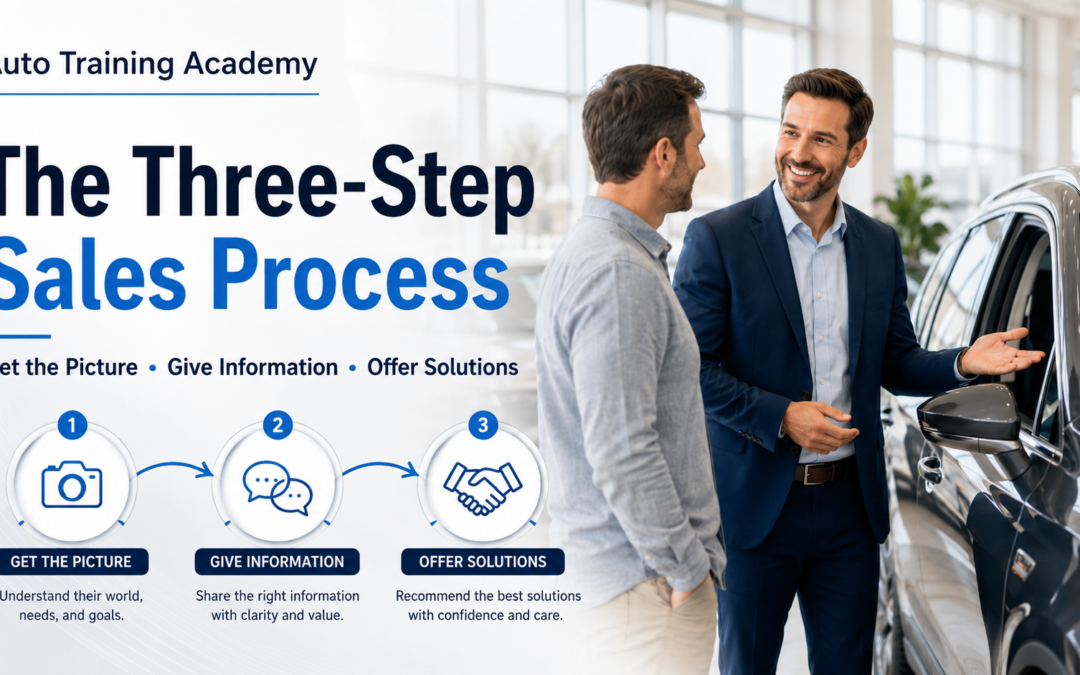
It comes down to three simple steps:
- Get the Picture
- Give Information
- Offer Solutions
This process works because it focuses on understanding and helping the customer rather than pushing a sale.
Let’s break it down.
Step 1: Get the Picture
The first step is understanding the customer’s situation.
This means asking questions and listening carefully.
You want to learn things like:
- what they currently drive
- what they like about it
- what they dislike about it
- how they use their vehicle
- what they wish they had instead
This step helps you uncover the customer’s Problems and Possibilities (PP).
Every buying decision happens because someone wants to move away from a problem or toward a possibility.
When you fully understand the customer’s situation, you’re able to recommend the right solution.
And that’s when selling becomes easy.
Step 2: Give Information
Once you understand the customer’s needs, the next step is providing helpful information.
At this stage, you’re no longer guessing.
You’re sharing information that directly relates to the customer’s situation.
For example:
- explaining safety features for a family with children
- discussing fuel efficiency for someone with a long commute
- showing cargo space for a customer who travels frequently
Because you took the time to Get the Picture, your information feels relevant and valuable.
The customer sees you as an advisor instead of a salesperson.
Step 3: Offer Solutions
The final step is offering solutions.
This is where you present vehicles that solve the customer’s Problems and fulfill their Possibilities.
Instead of showing random inventory, you’re showing vehicles that clearly match their needs.
You might say something like:
“Based on what you told me about needing more space and better fuel economy, I think this vehicle could be a great fit for you.”
When the solution matches the customer’s picture, the decision becomes much easier.
You’re not pushing a sale.
You’re helping them solve their transportation problem.
Why This Process Works So Well
This three-step process works because it follows the natural way humans make decisions.
First we understand the situation.
Then we gather information.
Finally we choose the best solution.
By aligning your sales process with how people naturally think, the entire experience becomes smoother and more comfortable for both you and the customer.
Selling Like a Second Grader
One of my favorite examples is how naturally children approach problem solving.
Second graders are naturally curious.
They ask questions.
They listen carefully.
They explore possibilities.
They don’t rely on complicated scripts.
They simply follow their curiosity.
When salespeople return to that natural curiosity and focus on helping people, selling becomes much easier.
The Result: Customers Trust You
When you use this process, something powerful happens.
Customers stop feeling like they’re being sold.
Instead, they feel like they’re being helped.
And when customers trust you, several things happen:
- deals close more easily
- customers come back in the future
- referrals increase
- your reputation grows
That’s how relationship businesses are built.
Want to Master Relationship Selling?
The automotive industry is full of sales training focused on scripts and pressure tactics.
But the most successful professionals know there’s a better way.
Inside the 100 Cars Club, learn automotive sales professionals how to master relationship selling using the simple three-step process:
- Get the Picture
- Give Information
- Offer Solutions
And how to:
- build stronger customer relationships
- increase referrals and repeat business
- simplify their sales process
- dramatically increase their monthly sales
This is the same philosophy that helped Ali Reda average over 100 cars per month.
Join the 100 Cars Club and start building your relationship business today.